.png)
What Is the Best Pipe for Underfloor Heating and Cooling Systems?

Underfloor heating and cooling isn't new. Europeans have used radiant floor systems for decades. But in India, it's only now gaining real traction, driven by green building certifications (IGBC, GRIHA), rising energy costs, and a growing number of MEP consultants who understand that radiant systems can handle 40-50% of a building's sensible cooling load while using significantly less energy than conventional HVAC.
The pipe buried in your floor screed is the most critical component of the system. It carries heated or chilled water through continuous loops, transferring energy to the floor surface above. If the pipe fails, the entire floor needs to come up. So the question isn't just which pipe works. It's which pipe works for 50 years without maintenance, buried in concrete, with no access.
The answer for most hydronic radiant systems is multilayer composite pipe (MLC), and here's the engineering case for it.
How Does a Hydronic Underfloor Heating and Cooling System Work?
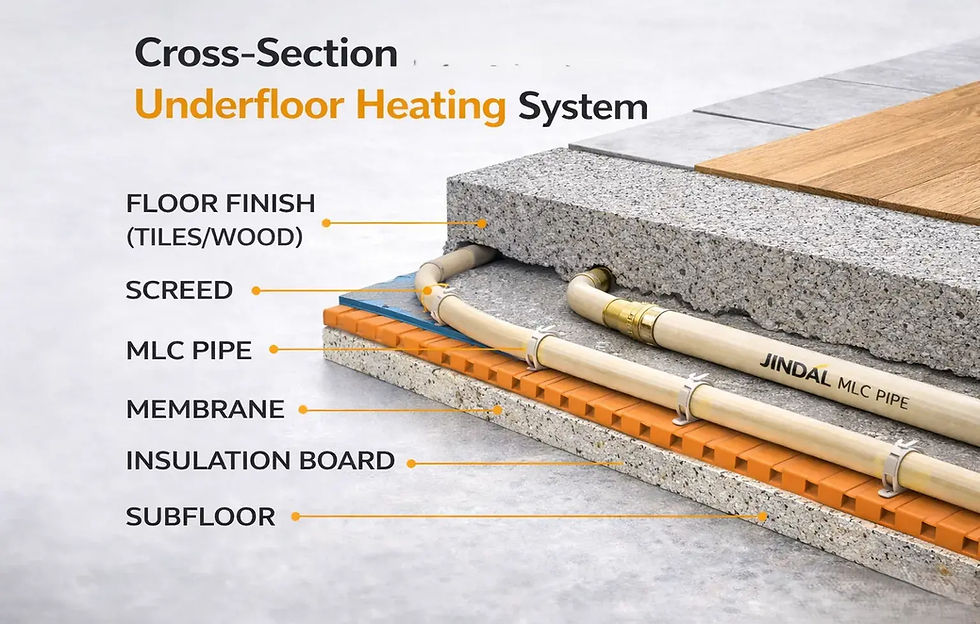
A hydronic radiant floor system circulates temperature-controlled water through continuous pipe loops embedded in the floor screed or slab. The water transfers thermal energy to the floor surface, which then radiates heat (in winter) or absorbs heat (in summer) into the room.
The core components:
Heat source: Boiler, heat pump, or solar thermal collector (for heating)
Cooling source: Chiller or heat pump operating in reverse (for cooling)
Manifold: Distribution hub that controls flow to individual pipe circuits
Pipe circuits: Continuous loops of pipe embedded in the floor screed, typically spaced 100-200mm apart
Controls: Thermostats and zone valves that regulate water temperature and flow per room
The pipe is the only component that's permanently inaccessible after installation. Everything else (manifold, controls, heat source) can be serviced or replaced. The pipe cannot. That single fact should drive your material selection.
What Pipe Materials Are Used for Underfloor Systems?
Three pipe materials dominate the global radiant floor market. Each has different properties that affect system performance, longevity, and installation.
PEX (cross-linked polyethylene):
Single-layer flexible plastic pipe
Good thermal conductivity and flexibility
No oxygen barrier (unless barrier-layer variant is specified)
Widely used in European and North American radiant systems
Sensitive to UV exposure during storage and installation
PERT (polyethylene of raised temperature resistance):
Similar to PEX but with a different molecular structure
Flexible, weldable, and suitable for hot water applications
No oxygen barrier in standard form
Lower cost than PEX in some markets
MLC / Multilayer composite (PE-AL-PE or PERT-AL-PERT):
Five-layer construction: polyethylene inner layer, adhesive, welded aluminium core, adhesive, polyethylene outer layer
Built-in oxygen barrier (aluminium core)
Lower thermal expansion than PEX or PERT
Retains its shape after bending (shape memory)
Certified under IS:15450 (2022) in India, ISO 21003 internationally
All three are used successfully in radiant systems worldwide. But for Indian conditions, MLC has specific advantages we'll break down below.
Why Is MLC Composite Pipe Preferred for Radiant Floor Systems?
MLC composite pipe is the preferred choice for underfloor heating and cooling because it combines a built-in oxygen barrier, low thermal expansion, shape memory after bending, and a 50+ year rated service life under IS:15450 conditions. These properties matter more in a radiant floor application than in almost any other plumbing use case.
Here's why each property matters in the floor:
Oxygen barrier is non-negotiable for system longevity. Radiant systems connect the floor pipe to metal components: boilers, heat pumps, chillers, manifolds, valves, and pumps. Oxygen permeating through the pipe wall enters the circulating water and corrodes every metal component in the circuit. Over 10-20 years, that corrosion degrades expensive plant equipment silently.
Standard PEX and PERT pipes don't have an oxygen barrier unless a separate barrier layer is added (and barrier-layer variants cost more). MLC's aluminium core provides a complete, permanent oxygen barrier as part of the pipe's structure. It's not a coating that can degrade. It's welded aluminium.
We've tested thousands of metres of MLC pipe at our Dehradun facility. The aluminium overlap weld is where quality separates good multilayer pipe from bad. If the weld isn't continuous and properly overlapped, you don't have a reliable oxygen barrier. That's a manufacturing quality point most guides skip.
Low thermal expansion protects embedded pipe. Pipe embedded in screed can't move freely. Thermal expansion and contraction from heating cycles creates internal stress at every bend and connection point. Over thousands of cycles across years of operation, high expansion rates fatigue the pipe and the screed around it.
MLC's thermal expansion coefficient is approximately 0.025 mm/m/°C. Standard PEX is around 0.14-0.20 mm/m/°C. That's 6-8x higher. In a radiant floor application where the pipe is locked in concrete and cycles between ambient and 35-55°C daily, that difference is significant.
Shape memory simplifies installation. When you bend MLC pipe, it holds its shape. You can lay it in a spiral or serpentine pattern and it stays where you put it. PEX has elastic memory and wants to spring back, requiring more clips and staples to hold the layout pattern. On a large floor area, that difference in installation behaviour adds up.
Pressure rating handles system demands. Jindal MLC pipes are rated at 13.8 bar at 23°C per IS:15450. Radiant floor systems typically operate at 2-4 bar, well within the pipe's rated capacity. The MLC Pro (PERT-AL-PERT) variant handles continuous temperatures up to 95°C, suitable for high-temperature heating applications including solar thermal integration.
Underfloor Heating in India: Where It Makes Sense
Underfloor heating isn't common across all of India, but it's growing rapidly in specific regions and building types.
Northern hill states (Uttarakhand, Himachal Pradesh, Kashmir, Ladakh): Winter temperatures regularly drop below 0°C. Conventional room heaters and blowers are inefficient and create dry, uneven heating. Radiant floor heating delivers consistent warmth from the ground up, with lower energy consumption. Premium holiday homes, resorts, and institutional buildings in Shimla, Manali, Mussoorie, and Kashmir are increasingly specifying underfloor heating.
Premium residential (pan-India): High-end apartments and villas in metro cities are adopting radiant systems for both heating (winter) and cooling (summer). The invisible nature of underfloor systems (no wall-mounted units, no ductwork) appeals to architects and interior designers working on premium projects.
Green-certified buildings: IGBC and GRIHA-rated buildings earn credits for energy-efficient HVAC approaches. Radiant cooling can handle 40-50% of sensible cooling load in most Indian climate zones, significantly downsizing conventional AC systems. Infosys built India's first radiant-cooled commercial building on its Hyderabad campus, demonstrating the technology's viability at scale.
Commercial and institutional: Hospitals, hotels, IT campuses, and government buildings where thermal comfort, energy efficiency, and noise-free operation matter. Radiant systems produce zero operational noise compared to fan-based HVAC.
Underfloor Cooling: The Emerging Application in India
Underfloor cooling is the bigger opportunity in India. While heating matters in a few states, cooling matters everywhere.
Radiant floor cooling works by circulating chilled water (typically 16-18°C) through the same embedded pipe network used for heating. The cool floor surface absorbs radiant heat from the room, lowering the perceived temperature without moving air.
Key points for Indian applications:
Radiant cooling handles the sensible cooling load (temperature). It doesn't handle the latent load (humidity). In India's humid climate zones, you still need a dedicated outdoor air system (DOAS) or dehumidifier for moisture control.
In most Indian climatic zones, radiant cooling can address 40-50% of sensible load at indoor temperatures of 24-25°C, as noted by Fairconditioning.org's radiant cooling research.
The energy savings come from downsizing conventional HVAC, not eliminating it entirely.
Condensation risk management is critical. Floor surface temperature must stay above the dew point to prevent moisture formation. This requires proper controls and humidity monitoring.
For cooling applications, MLC pipe's low thermal expansion is particularly valuable because the pipe cycles between ambient temperature and chilled water temperatures daily, creating thermal stress that accumulates over years of operation.
Pipe Sizing and Layout for Radiant Floor Systems
Radiant floor pipe sizing depends on the room's heat load, desired floor surface temperature, water temperature, and pipe spacing. Here's a practical overview.
Common pipe sizes for underfloor systems:
16mm OD: Most common for residential applications. Allows tighter bending radius and closer pipe spacing.
20mm OD: Used for larger rooms or commercial applications where higher flow rates are needed.
Pipe spacing: Typically 100-200mm centre-to-centre, depending on heat load. Closer spacing delivers more output per square metre.
Circuit length limits:
Maximum circuit length is typically 80-100 metres for 16mm pipe to maintain adequate flow and avoid excessive pressure drop.
Each circuit connects back to the manifold.
Larger rooms may need multiple circuits.
Bending radius:
MLC pipe minimum bending radius is typically 5x the outer diameter (80mm for 16mm pipe).
This allows tight spiral and serpentine layouts without kinking.
We see contractors on their first radiant project worry about kinking MLC. The trick is steady, even pressure. Don't force a tight radius. If you're fighting the pipe, the bend is too tight.
Layout patterns:
Spiral (snail): Most common for rectangular rooms. Even heat distribution with alternating hot and return runs.
Serpentine: Used for smaller or irregular spaces. Creates a temperature gradient across the room.
For specifying pipe quantities and layouts on your project, download the complete Jindal product catalogue from the downloads page.
MLC vs PEX for Underfloor Systems: Quick Comparison
Property | PEX | PERT | MLC (PE-AL-PE) |
Oxygen barrier | Only if barrier-layer variant | Only if barrier-layer variant | Built-in (aluminium core) |
Thermal expansion | ~0.14-0.20 mm/m/°C | ~0.14-0.20 mm/m/°C | ~0.025 mm/m/°C |
Shape memory | Springs back (needs more clips) | Springs back | Holds shape after bending |
Indian standard | No specific IS code for radiant PEX | No specific IS code for radiant PERT | IS:15450 (2022) |
Pressure rating | Varies by manufacturer | Varies by manufacturer | 13.8 bar at 23°C per IS:15450 |
UV sensitivity | High (protect during storage) | High | Low (PE outer layer + aluminium) |
Typical lifespan | 25-50 years (manufacturer dependent) | 25-50 years | 50+ years under IS:15450 conditions |
Best for radiant floors | Yes (with barrier layer) | Yes (with barrier layer) | Yes (barrier built in) |
All three work. But MLC's integrated oxygen barrier, lower expansion, and shape memory make it the most reliable long-term choice for embedded applications where pipe replacement isn't an option.
For a broader comparison of MLC against other pipe materials for water supply applications, see our Composite Pipe vs PVC vs CPVC comparison guide.

Installation Considerations for MLC in Radiant Floors
Pipe connection to manifold: MLC connects to the manifold using compression fittings or press fittings. Both create reliable, permanent connections. Compression fittings are more common at manifold connections because they allow easy removal if a circuit needs to be isolated.
Screed embedding: After laying the pipe circuit on insulation board, screed (typically 50-75mm sand-cement or anhydrite) is poured over the pipes. The screed acts as a thermal mass, storing and distributing heat evenly across the floor surface.
Pressure testing before screed pour: This is critical. Pressure-test every circuit to at least 6 bar for 24 hours before the screed is poured. Once concrete covers the pipe, finding and fixing a leak is extremely expensive. With MLC press fittings, you can pressure-test immediately after installation with zero cure time.
Insulation below pipes: Insulation board below the pipe circuits is mandatory. Without it, heat transfers downward into the slab rather than upward into the room, reducing system efficiency by 20-40%.
Across projects in Uttarakhand and Himachal Pradesh, we've seen contractors skip the insulation layer to save cost. That's a false economy. The system runs hotter, uses more energy, and heats the structure below instead of the room above.
What About GI Pipe or CPVC for Radiant Floors?
Neither GI pipe nor CPVC is suitable for underfloor radiant systems.
GI pipe is rigid, corrodes internally, and can't be bent into the tight spiral layouts that radiant floors require. It's the right material for fire risers and structural applications, not for embedded radiant circuits.
CPVC is rigid, requires solvent cement joints (every joint in the screed is a potential failure point), and has 2.5x the thermal expansion of MLC. Embedding dozens of solvent-cemented joints in a concrete floor is a long-term reliability risk that no MEP consultant should take.
Radiant floor systems need flexible, low-expansion, oxygen-barrier pipe that can run in continuous circuits from manifold to manifold with zero joints in the screed. That's PEX (with barrier), PERT (with barrier), or MLC. And of those three, MLC has the barrier built in.
Frequently Asked Questions
What is the best pipe for underfloor heating in India?
Multilayer composite pipe (PE-AL-PE or PERT-AL-PERT) is the best choice for Indian underfloor heating systems. It provides a built-in oxygen barrier, low thermal expansion (0.025 mm/m/°C), holds its shape after bending, and is certified under IS:15450 (2022) for hot and cold water applications up to 82°C (95°C for PERT-AL-PERT).
Can the same underfloor pipe be used for both heating and cooling?
Yes. The same embedded MLC pipe circuit carries heated water in winter and chilled water in summer. Controls and the manifold adjust water temperature based on the season. The pipe stays the same. This dual-use capability is one of the key advantages of hydronic radiant systems.
Does underfloor cooling work in India's humid climate?
Radiant floor cooling handles sensible cooling (temperature reduction) effectively. It doesn't handle latent cooling (humidity removal). In India's humid climate zones, you need a supplementary dehumidification system (DOAS or standalone dehumidifier) alongside the radiant floor to prevent condensation on the cool floor surface.
What pipe size is used for underfloor heating?
16mm OD is the most common size for residential radiant floor applications, allowing tight bending radius and close pipe spacing (100-200mm). 20mm OD is used for larger commercial installations. Maximum circuit length is typically 80-100 metres for 16mm pipe to maintain adequate flow rate.
Is underfloor heating expensive in India?
Initial installation cost is higher than conventional heating because it requires pipe, insulation, manifold, and screed work. However, operating costs are 20-40% lower than conventional HVAC systems because radiant systems use lower water temperatures and distribute heat more evenly. Over 10+ years, the total cost of ownership is typically lower, especially in regions with sustained heating requirements like the northern hill states.
Specifying Radiant Floor Piping for Your Project?
If you're an MEP consultant, architect, or builder designing an underfloor heating or cooling system, explore the full Jindal MLC Pipes range with size charts, pressure ratings, and IS:15450 certification details. For high-temperature heating applications (solar thermal, centralised boilers), the MLC Pro (PERT-AL-PERT) handles continuous operation up to 95°C.
We've supplied composite piping systems to 900+ projects across India. Get in touch at +91 8750075007 or submit an enquiry through our contact page for project-specific technical support, pipe sizing guidance, and pricing.


Comments